Meeting Mr. Paleo!

Is there anything more exciting than a health conference???

Well, there is always chocolate, but the conference excitement is quite comparable.
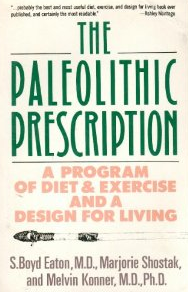
ImageArizona State University has organized a great conference “Nutrition for Optimal Health and Performance”.  Today’s lecture included speakers on athletic nutrition, debate on the High-Fructose Corn Syrup, and Paleolithic Nutrition.  Right now I shall focus on the Paleo presentation.

S. Boyd Eaton, MD from Emory University is considered the “father” of the modern paleo movement (you would know him from the Paleolithic Prescription book). He himself considers himself the “grandfather” since much of his original ideas have been somewhat transformed by other (younger) researchers (and he does not necessarily agree with all).

The Hypothesis

The presentation was not new to me, since I have read several of his papers.  In short, Dr. Eaton talked about the basis for the paleo health idea- the “discordance hypothesis“, according to which our genes and our lives are discordant (we adapted to a certain food and activity pattern, which is not matched by the modern sedentary/processed foods lifestyle)… The mismatch of the current obesogenic environment and our stone age genes are the reason we suffer from “western” diseases.  The human of 40,000 to 15,000 years ago is fundamentally identical to the modern human.Screen Shot 2013-02-08 at 8.35.37 PM

Then Dr. E talked about different % of meat subsistence of recent hunter gatherers which ranges from 20% animal products to 95%.  They/anthropologists take the 50% of animal protein in the diet  as the model due to the idea that most of us come from the savanna region of Africa (with 50% animal dietary intake).

He also discussed that anthropologists have rather good ways of studying old diets (human skeletal remains, archeological finds, recent hunter-gatherers, and proximate nutrient analyses).

The “Ancestral” Diet

The Paleo-Nutrition of East Africa (~50,000 years ago) is considered to be comprised of 35%, 25-35% protein, and ~35% carbohydrates. Of course the carbs, protein, and fat of long ago and the present day are not the same (obviously, less processed and more micronutrient rich; the fat was more polyunsaturated, more long chain PUFA, and less cholesterol-raising fat).  Other noted differences – vitamins and minerals were 2-8 times higher than average American intake; much higher potassioum-to-sodium ratio, the diet was more basic than modern acidic diets, and much more antioxidants than at present (generally 4x). Dr. E especially emphasized fiber- vegetables in the wild are much more fibrous.  Lastly, the energy intake was considerably higher, but caloric density was low (there was more bulk- more fiber, more water in food). Dr. E also talked about “free water intake”- most of the fluids consumed were part of the vegetables&fruits.

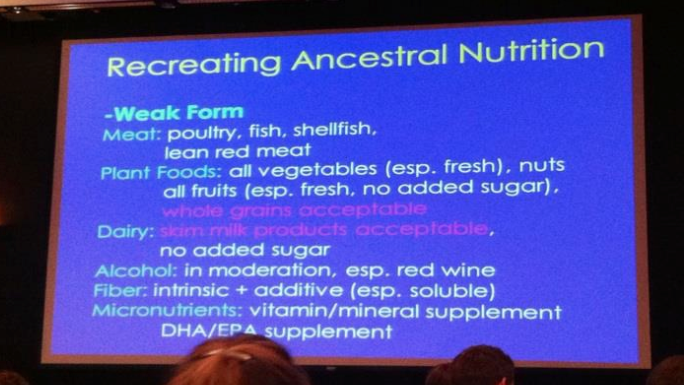
That’s all great, but here is something that was new to me. Dr. E himself differentiated between the “weak” and “strong” forms of the paleo prescription. It’s hard to say what all forms of “paleo” people out there are following, but my impression is that folks try to stay pretty strict with what they believe our “ancestors” ate. For a healthy normal individual, however, Dr. E’s weak form consisted of-
Image

The strong form (which seems to be the popular form as I can tell from talking to folks) is for people with “resistant health problems or who are unable to maintain desirable biomarkers” + competitive athletes.  This diet is what you would usually recognize as “the paleo diet”completely excludes grains, dairy, and alcohol.

The AfterLecture

The most exciting part for me was listening to Dr. E talk to a group of people after the presentation. A dietitian asked about the lack of legumes and beans in the paleo diet (she was upset about such nutrition advise). He commented that this was not something he necessarily agreed with at all, and that this idea originated with a different researcher (sorry, I can not remember who).  My friend asked how he viewed a paleolithic diet without meat (she is mostly vegetarian).  He said his understanding of meat avoidance is very much justified on ethical and moral grounds, considering the treatment of animals and their health (thus, the healthiness of their meat).  And if one could get their protein adequately from other sources that was great too. So he was not particularly married to one type of the ultimate human diet. Overall, Dr. E was a pleasure to be around.

My Comments on Meat Avoidance

Another dietetics student, who I know is a vegan since we are both involved in a vegetarian study, asked how he would respond to the massive literature on the health benefits of vegetarian diets and the problem of saturated fat from meat. Dr. E “politely disagreed” that vegetarianism was necessary for health but did not elaborate as much as we hoped. I understand the doc does not view being vegetarian as necessarily more healthy (considering you could do paleo with grass-fed free range meat and all). But I also wish he could talk about this further.Screen Shot 2013-02-08 at 8.29.54 PM

As someone who was vegan for 2 years and is very familiar with various health rationales for avoiding animal products, I have come to the conclusion that it is not necessary to exclude these products from the diet for health. Many cite The China Study by T. Colin Campbell, which is a book I also used to refer to (in brief, it shows the connection between animal protein and cancer). However, after looking into people who eat “traditional” diets (e.g. the Weston A. Price foundation diet), and seeing the vibrant health they enjoy… I had to come to the conclusion that all is not as black & white as I expected. In regards to meat & cancer, I am fascinated by new information on mTOR. Since I plan to post about mTOR in depth later, I will only say that it is a pathway that can be up-regulated if excess protein levels are detected in the body…in turn this stimulates cellular proliferation and adverse mitochondrial effects. In short- too much protein= increased risk of cancer. But note here that animal protein only in excess leads to adverse health effects, not animal protein per se. Supposedly, 45-60 g of protein per day for the majority of adults is a good amount* for longevity and avoidance of disease.

It was a pleasure to actually talk to the originator of the “paleo” movement, who himself is very balanced and rational in contrast to how the idea can be taken to extremes by many different people. The one thing Dr. E said is that obviously it is not sustainable for everyone to eat a paleo style diet any more, unless we decreased the world’s population drastically. Obviously, that is a different talk altogether.

*Gedgaudas CNS, CNT, Nora T. (2011-05-27). Primal Body, Primal Mind: Beyond the Paleo Diet for Total Health and a Longer Life (p. 196). Inner Traditions Bear & Company. Kindle Edition.

What makes us FULL? (macronutrient perspective)

Sometime in the semester, I heard people speak about satiety (satiation is the process of feeling full & terminating food ingestion during the course of eating) in relation to protein and fat (protein apparently is more satiating, even though fat has more calories).  Feeling of fullness is important- it is one of the problems I faced as a raw vegan, which made sticking to the lifestyle very hard long-term (I was raw vegan for ~2 years).

So instead of preparing for class tomorrow, I am reading up on satiety! Some main points:

Most importantly- it’s not all about the calories, since not all calories are treated equally by the body.  The hierarchy of fullness is the following: Protein > Carbs > Fats. So, protein satiates more than carbohydrates, and fat is least satiating (which came as a surprise to me considering it has most calories per weight). High-fat foods have a weak effect on satiation.

Image

Within the macronutrient categories, we find differences too: not all carbs exert the same effect on satiety (fiber has been consistently shown to have a higher satiety value vs. simple sugars), and neither does fat (the medium-chain triglycerites [e.g. the wonderful coconut oil] seem to be more satiating).

Of course, people don’t eat only to get full. The number 1 reason given for eating a certain food is taste. More specifically- palatability (subjective pleasantness of food). Low-energy-dense foods tend to be less palatable, but more satiating :/

According to the article*, ideally our diet would consist of low-energy-dense foods with high palatability (unfortunately such foods are not very common). This “diet” is one low in fat, has adequate protein and fiber, and includes lots of fruits, vegetables (so food with high water content).

Of course, focusing on whole foods vs. processed makes lots & lots of sense- a whole food product takes time to chew and digests longer (satiety signals are maintained for longer).

Apart from specific studies, common sense must prevail: staying away from “fat” is not necessary (not as much as staying away from processed fat, vegetable oils, etc…), and adding great fats (e.g. avocado!) to meals is both healthy and filling (studies show that while fat on its own is least satiating, it’s power to fill us up increases when it is added to carbs).

Feeling full is important! Constantly feeling deprived could potentially lead to overeatingand more stress.

P.S. I shall probably post more on the subject of satiety later, considering I have a whole class coming up on this topic 😀

*Gerstein, D. E., Woodward-Lopez, G., Evans, A. E., Kelsey, K., & Drewnowski, A. (2004). Clarifying concepts about macronutrients’ effects on satiation and satiety. Journal of the American Dietetic Association, 104(7), 1151–3. doi:10.1016/j.jada.2004.04.027

SPICE up your health!

Could SPICY FOOD make you HEALTHIER!?

While spicy foods are not particularly pleasant to the taste (the sensation they can create can be even that of pain) many people love spicy food! Indeed, spices have been highly valued and fought for throughout history! So other than enhancing the taste of food, perhaps there are other more potent reasons for their importance throughout the world?

Image

I’m reading a fascinating study* on the subject, and the authors hypothesize that adding spices to food is beneficial since they contain substances that inhibit or kill food-spoilage microorganisms (we know certain spices have antioxidant & antibacterial properties; others are powerful fungicides).

In short, the authors looked at traditional cookbooks, spices used in meat-based dishes, and country’s climate (since meat products in hot temperatures would spoil fastest).

The most used spices for the ~4,580 recipes analyzed were onion and pepper, followed by garlic, capsicums, lemon/lime juice, parsley, ginger, and bay leaf. The average spice was found to inhibit ~ 67% of bacteria (garlic, onion, allspice, and oregano inhibit EVERY bacterium they’ve been tested on!). It was found that more powerful spices were used more frequently in hotter climates= recipes from those countries have more antibacterial potential! Lemon and lime juice use appears to be strange- it is used a lot, while it has one of the lowest effects against bacteria. These juices, however, are syngergists (as well as pepper)! They act synergistically to enhance antibacterial effects of other spices.

HMMM…

Now as I was reading this, I thought- maybe hotter countries simply have more spices growing there? The authors found out that there was no relationship between a country’s mean annual temperature & number of spice plant species growing there.

Another problem I imagined- what about cooking? Perhaps heat destroys some of the antibacterial and other effects of spices? Turns out spices are thermostable and have similar effect even after steam-distillation.Image

INTERESTING fact I didn’t know- plant secondary compounds & essential oils can contain mutagenic, carcinogenic, and allergenic effects.. and while protecting oneself from food-borne illnesses outweighs the dangers of these chemicals, it would explain why kids and some pregnant women might dislike spices. [in the modern obesogenic food environment with french fries and twinkies, potentially negative health of spices should not be on top of our concern list]. Also important- medicine is pretty much a low dose of poison…so spices have been used to counteract ailments of all sorts (e.g. garlic for pneumonia, worms, etc). Animals are capable of self-medicating with strong-tasting vegetation as well.

In CONCLUSION, the authors believe that the main reason for spicy foods is to take advantage of the antimicrobial actions of the secondary compounds in plants… which contributes to survival, health, and reproduction. Therefore, many people (especially in hot climates) prefer spicy food. If you like it HOT- GOOD FOR YOU 😀

* Billing, J., & Sherman, P. W. (1998). Antimicrobial functions of spices: why some like it hot. Quarterly Review of Biology, 3-49.

p.s. this of course is not to be the only explanation why spicy foods are liked, there is also social learning and what not 😉

“Listen to your body”?

Could your body “tell” you what to eat due to its health state? If you’re deficient in a certain nutrient…will you instinctively crave foods with that nutrient?

Many believers in the “body wisdom” would say yes. Actually, i think the idea of body wisdom is extremely popular- I myself know this from the raw diet, and I am sure many alternative “natural” diets talk about this concept (e.g. intuitive eating?). Unknown

I think it is fascinating- that’s why I was excited to talk about this in my psychology of eating class. I tried to find a relevant peer-reviewed article for class discussion, but to my surprise found nothing. In class I understood why- there is no evidence for body wisdom in the literature. There originally was an idea that our bodies can tell what we are deficient in and gravitate towards foods with those nutrients- first rat studies seemed to prove that.  They had rats on a thiamine deficient diet choose between two new diets- one with thiamine, or the previous thiamine deficient one. The rats chose the thiamine diet. They could tell they needed vitamin B1, right? Not really- turns out the rats avoided the same thiamine-deficient diet not because they could sense the deficiency, but due to the learning that the original diet made them somehow sick.  Animals, thus, avoid eating whatever doesn’t make them feel good. They, like we, learn to eat what makes us feel good. The only thing you can have a specific hunger for (so you’d be able to choose food with that particular nutrient in it) is salt- it is easy to taste/identify and we have a genetically preprogrammed specific hunger to it.

Generalist vs. specialist?

When you think about it, animals seem to KNOW what to eat, what’s good for them (I hear people argue we have that ability too, or “body wisdom”). But let’s think about it…an animal that specializes in one kind of food (e.g. carnivore, insectivore) has a very narrow range of foods..they must get all essential elements from those foods= the identification of food can be programmed genetically into them. But for a species that eats anything(or “generalist” animals)e.g. humans– the problem of finding food can be less demanding since there are many potential sources..and eating a nutritionally balanced diet can be achieved in many ways. Perhaps that’s why our body wisdom is not as acute- we are not dealing with a narrow range of foods. (See Paul Rozin for more)

SO?

I don’t know whether specific body wisdom really exists- the one that can signal you to eat a certain food because of a B vitamin you’re low on. Either way, I think we have access to a different kind of wisdom- choosing whole unprocessed foods is much closer to our evolved physiology than any of the new created foods that seem to be destroying our health. Apple vs. apple juice- that seems wise 😀

Gluten Free for a happier life!?

So Gluten Free is a rather growing popular dietary approach. Obviously, those suffering from celiac disease absolutely need to avoid gluten, and some believe many people have some degree of intolerance to gluten…others claim our bodies are simply not designed to process it.

I am currently working on a literature review on functional foods (including GF) and am reflecting on my own recent purchase of GF bread.

In fact, I do not eat bread (a diet food practice I brought with me from Ukraine), and yet I got GF bread for the house…

Why do we think GF is healthier? Is it simply because the “free” part is associated with other “free from” foods that are supposedly healthier? (fat free! sugar free!) Usually “FREE” would mean something bad has been removed from the product.

Is it because we see many celebrities adopt the lifestyle, lose weight, look chic, and twit about it? They must know what they’re doing…(?)

Is it our beliefs about the nature of health and the way our body evolved? I’ve heard many people quote the “10,000 year” point- that agriculture is rather recent and our bodies have not adopted to processing grains and gluten (this is inspired by the paleo information).

Does it matter? The truth is many people feel better when they go GF- more energy, better digestion, and more. I personally doubt it is the gluten primarily (unless someone truly is sensitive!?)- many going GF simultaneously improve their diet and lifestyle. Indeed, many poeple going GF are health-conscious individuals in general (health consciousness is the degree to which one plays an active role in maintaining their health).  It is obvious that in the modern civilized world the pursuit of health, responsibility for one’s well-being and self-improvement are central themes.

I personally avoid gluten on a typical day- I already am not a fan of grain and breads (my Ukrainian family&friends always emphasized getting rid of baked items to maintain weight)…besides, due to gluten’s fantastic binding ability, it is added to most foods and it could be its unprecedented overconsumption in the last several decades that makes us sensitive.

Eat healthy for healthy kids!

Looks like a varied healthy diet is important before a kid is even able to eat solid foods. Specifically, it is important for pregnant and breastfeeding mothers, since a child’s first experiences of flavor occurs prior to birth through milk feeding and amniotic fluid in utero.

SO eating a variety of vegetables and fruits influences acceptance of these foods at the weaning stage (~5.7 months).

Breastfeeding is crucial (vs. formula-feeding), since it prepares kids for novel flavors through the mother’s diet being transmitted to milk [Flavors so far known to be transmitted through breast milk are garlic, ethanol, carrot, mint, blue cheese, and cigarettes]. If formula-feeding is the only option, it is important to switch formula flavors and types to allow for variety.

Conclusion: varied diet in pregnancy and during breastfeeding is recommended.  Some suggest that up to 6 month is the period we are most sensitive at for introduction of different flavours..and that we are never again as open to new experiences!*

Note: repeated exposure to one flavor can become monotonous and actually decrease liking in a child.. so that would be counterproductive (again, variety is good!).

Lastly..

Being overweight or having a “junk” diet (for mothers) can be potentially detrimental for kids.

1. Being overweight/obese is a risk.. The problem- overeating and obesity during pregnancy lead to in utero overnutrition..and can cause the development of obesity in the adult offspring (even when the child had normal feeding and lactation).

During pregnancy leptin resistance and hyperphagia occur, which lead to increased deposition of fat.. In lean individuals this is a great adaptation allowing mothers to store energy in preparation for lactation (a high metabolic demand activity).. But in the current “obesogenic” environment this adaptation would make it hard for women to regulate their food intake (especially those predisposed to obesity).**

2. While I haven’t found a study on humans, studies on rats show that rats born to mothers fed junk food during gestation & lactation developed an increased preference for sugary, fatty, and salty foods; they also exhibited increased weight and BMI. Data from numerous studies shows that maternal junk food diet can change the ofsprings’ epigenetic marks related with long-term changes in gene expression (opiods & dopamine) and behavior (stronger preferences for palatable foods- sugar/fat/salt).***

* Article doi:10.1016/j.appet.2011.05.317

** Article doi: 10.1210/en.2008-1106

*** Article doi:10.1210/en.2010-050

Loving it healthy!

Reading yet more articles on the psychology of eating…

How do we learn to like certain foods?

Image

Well, we learn when it makes us feel good (we feel full, the sweet taste is pleasant), because other people do so (we model behavior of others, eat what our culture things is appropriate), and because it’s something we’ve eaten many times (we’re exposed to a certain food since childhood).

Food neophobia is the fear of new foods in kids (starts ~ age 2). It’s an important trait since it serves a protective function (you can get poisoned by eating unknown foods), but at this time in history with diverse food environment it might limit kids’ diet for the worst.

Learning through exposure (repeated tasting) is a way to make young children eat food that they don’t seem to like. [Between 50-60% of variance in preference for foods in 4-year olds is explained by its sweetness and degree of familiarity!]

For a 2 year old, ~10 attempts might be necessary to make them like a new food (usually vegetable 🙂 It’s important to space these attempts and be persistent (most parents just give up after trying to give one food several times). So e.g. you can give a red pepper in small portions daily over the course of the week and eventually your kid will like it!

The number of attempts goes up with age ( 4-year old- ~15 attempts; 10-year old- up to twenty exposures to the food may be necessary).

You want your kid to enjoy vegetables later in life- start them early by giving it to them at a young age and don’t give up 😀

Psychology of Eating

Just out of my Psychology of eating seminar and wanted to jot down a couple of new things I’ve learned.

We were talking about Flavor-Flavor learning- you can learn to like a certain food/flavor by pairing it with the flavor you already like (adding sugar [sweet flavor] to oatmeal). This is quite useful to humans as a “short cut” for eating foods that are safe and energy dense and avoiding potentially harmful ones= sweetness is preferred since in nature a fruit would also have an array of valuable micronutrients important for health; bitter taste is disliked since it is associated with poisonous foods, etc.

Either way, here are a couple of interesting facts I learned today-

CALCIUM makes things taste bitter; thus lots of leafy-green vegetables are not liked by people. But you can learn to like them if you pair these vegetables with, for example, sweetness or fats (think of a green smoothie kale+banana+nut butter).

ImageAlso, adding sugar to bitter foods makes them taste less bitter; adding sour- more bitter.

Most recent meal is associated with fullness, so if you eat a regular meal followed by dessert- you will associate dessert with fullness. To associate healthier foods with satiety, eat dessert first! 🙂 

It is important to remember that virtually ALL of our food preferences are learned rather than innate, so you can teach yourself to eat healthier by liking it more!

Welcome!

I am in my first year of the PhD track in Global Health (GH). While GH is interdisciplinary, my main grounding is in medical anthropology*, and my specific interest is nutrition. I am not an anthropologist by training- my undergraduate degree was in business, my master’s degree- in health promotion. I have always had an interest in nutrition- first personally, then academically. I myself tried all sorts of diets and eating styles- I became most interested in the raw vegan diet in 2007; got certified as a raw chef and educator; taught classes as the health food store I managed; was a private raw chef, and so on.

Currently, I am interested in exploring how people use food as medicine. I plan to focus on the raw vegan diet and the “paleo diet”- two examples of eating styles that are often perceived as pristine or “the way we are meant to eat”.

I will be posting thoughts and information I encounter along the way. My goals are to explore:

-how to eat to feel good, look good, and maintain health

-how food can affect our health, mood, looks,etc.

-psychology of eating (why people at what they eat, etc)

*Medical anthropology(MA) attempts to understand human health and illness, in short. The longer explanation is:

MA is the study of health, illness, healthcare, & related topics from a broad anthropological perspective. It draws upon cultural, biological, and linguistic anthropology to better understand those factors that influence health & well being, experience & distribution of illness, prevention & treatment of sickness, healing processes, social relations of therapy management, and cultural importance of pluralistic medical systems.