This week on ASU campus I managed to attend a fascinating talk: Reconsidering the Role of Plant Foods in Hominin Diets by Dr. Chelsea Leonard. 
It was a job talk for the Evolutionary Anthropology department here at ASU and Dr. Leonard is an evolutionary ecologist interested in “human foraging decisions & diet reconstruction”(so- her work would help to clarify what humans ate in the past!) working with Twe populations in Namibia (southwest Africa).
Why does Dr. Leonard study the role of plants? Since shifting towards more meat in diets of early humans has been suggested to be crucial for the unique adaptations in our genus (e.g. large brains), animal foods appear to be very  important. There is indeed a strong case for meat in a human diet- in comparison to chimpanzees who are mostly herbivorous (eat plants), the human gut has opposite proportions- our small intestine is much longer, while the colon is a lot shorter. The colon is where fiber fermentation occurs- something crucial if you are eating lots of plant foods (and wild plant foods are very high fiber!). What Dr. Leonard suggests, though, is that meat’s importance in human diets may be quite overstated (especially in meat-heavy “paleo” diets popular now).
The people she studies- Twe- are “forager-horticulturalists”; while the Namibian government has been providing maize for them (this started very recently, in the last 7 yrs or so), they mostly forage for wild foods and have very low intake of animal products. Apparently, historically this population hunted large game and had a higher meat intake.. but the area is very poor in large animals now (and has been this way for ~200 yrs).
While I wont’ be able to describe everything Dr. Leonard discussed, I found the following fascinating.. Based on her observations and interviews with the Twe, she constructed and analyzed a hypothetical (yet realistic) diet for this region. Since Twe seem to be doing just fine health-wise with an extremely low animal food intake (there might be some birds, insects, rodents eaten from time to time), she wanted to test if their meatless diet truly meet basic nutritional requirements. 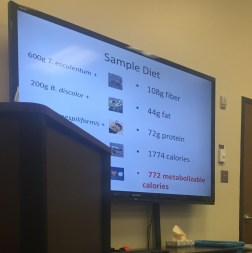
Based on the plants the Twe regularly eat, her analysis showed that such meatless diet can realistically provide enough protein (it can reach minimum levels of essential amino acids our body can not produce without foods that contain them), it can also provide enough fat (while most plant sources were extremely low in fat, the grass seeds often eaten are rather high in it). The main issue with this meatless diet was calories. Getting enough calories to survive would be improbable : while the hypothetical food intake reaches 1774 calories a day.. only 772 of them are metabolized. What this means is that a lot of these calories are not available to the human body- since humans can not ferment fibers very efficiently, a lot of this rough wild plant fiber is indigestible and does not provide our body with energy.
The main issue with this meatless diet was calories.
Since foraging for wild plants is very labor intensive (and this does not really mean standing around picking berries, but e.g. digging up roots that are about 1 meter (~40 inches) into the ground, or grinding grass seeds and cooking them into porridge), there isn’t enough time in a day to get enough digestible calories from foraging. So animal products are more efficient and provide a concentrated mix of not only essential nutrients, but fat, protein, and calories. While the speaker couldn’t quite estimate the % of calories coming from small game (the birds, insects, etc.), it was very small but still was a part of this population’s diet [note: any time honey was available, it was eaten in large amounts and rather adored, apparently!]. Thus, while a vegetarian diet can be maintained in our modern world with plentiful food supply (and supplementation), it was not possible for non-industrialized populations.
humans are highly adaptable as we span huge geographical areas, and thus no single “diet” “made us human”
We know humans are highly adaptable as we span huge geographical areas, and thus no single “diet” “made us human” (thus, there is no one Paleo Diet). Yet plants are extremely important in our history- we see that they can sustain populations in good health to a very large degree. One issue with studying the role of plants in human diets is that they do not last well archeologically (e.g. it’s much easier to find evidence of large game being consumed, because their remains last well).
while a vegetarian diet can be maintained in our modern world with plentiful food supply (and supplementation), it was not possible for non-industrialized populations.
Overall, this was a really great talk! It also reminded me of a paper I read on the significance of plant foods in human evolution, which I talked about HERE.
[note: if you are an evolutionary anthropologist sand have any edits/clarifications to my post, please comment! I am not an evolutionary anthropologist :)]


 Mariya V. PhD