Posts like these.. drive me just slightly crazy these days.
I don’t blame anyone for getting affected by them.. but let me tell you a little story about banning “bad” stuff by other more enlightened countries who are apparently less evil and profit-driven than US (insert eyeroll).
This summer I interviewed participants in Ukraine as part of my project on food and health perceptions. Several of my respondents happened to be lawyers.. One of the topics under discussion was GMOs (genetically modified organisms). The non-GMO stickers have been put on foods in the country since at least 2013 when I visited last. Anything from foods to chewing gum to water bottles boasted the round green NO GMO sticker. Most people I discussed it with actually acknowledged it was simple marketing and didn’t place much trust in the stickers anyway..
So when this July my interviewees mentioned that “well, you HAVE to have the non-GMO label in Ukraine”, I thought they meant that brands just needs to keep up with the competition in hopes of selling more of their product under the illusion of naturalness and purity (big deal for Ukrainians, who still live with the Chernobyl accident of 86, and still worry about environmental pollution in foods).
Well, No- i was told. Ukraine in fact passed an actual law somewhat recently forbidding the import, export, production, or sale of foods with any GMOs. So if you want to place a product on the shelves of Ukrainian stores, they simply have to be certified non-GMO.
Oh! OK… what about reality? In actuality, if you’re placing that product on Ukrainian shelves.. you just pay to get the label put on. Ta-da, it’s non-GMO!
It is all so political, that discussions of population health are mostly for decoration..
Posts like that mentioned above are designed to get you thinking with indignation “I can’t believe my country is so interested in profits!.. they sacrifice our health while other countries actually care about their people’s well being..”. But why do you think Ukraine banned GMOs? It’s to make $ off the new certification and labeling procedures, it’s to look cool in front of Europe (we really want to be accepted to EU, mkay), it’s to keep our image as a serious exporter of quality agricultural products (hey, Ukraine wants to stay the famous breadbasket of Europe! And demand for “clean” or eco agriculture is big. You can’t afford to lose your place in that market)…
It is all so political, that discussions of population health are mostly for decoration (not like absolutely nobody cares, but that’s not the main reason for any of these policies). And of course this is not just Ukraine- I’m just telling you a short specific story. Either way, poor regulatory practices in the country mean that anyone can buy that non-GMO label: nobody’s testing anything and nobody is checking compliance, guys.
Exciting day! Another diet-related talk at ASU’s Center for Evolution & Medicine. This was a nice break from the horror that is the last 2 weeks of the semester..
It’s taking me awhile to “digest” all the information (hehe), but I found the seminar fascinating and wanted to summarize some main points. Lots of open questions remain, but John Pepper of National Cancer Institute really shows how examination of any health problem needs to focus not only on proximate causes, but the ultimate or evolutionary causes.
So.. Pepper asks- why is mammal meat bad for humans, specifically?
Meet Dr. Pepper!
In humans, red meat (he refers to it just as mammal meat) is linked to inflammatory diseases (cardiovascular, alzheimer’s, arthritis). What’s the mechanism behind this?
The inflammation from mammal meat has to do with our antibodies attacking something coming from other species.. When we eat mammal meat, we in fact incorporate something non-human from the diet- sialic acid.
Both human and other mammals have sialic acid in their tissues, actually, but humans have a unique mutation that replaces the form found in other mammals (ancestral form- Neu5Gc) with a different one- uniquely human (Neu5Ac).
So.. if we eat meat we get the new aquired ancestral sialic acid, it becomes part of our cells, and the small structural differences in the two get recognized by the immune system.. which responds with a defense- inflammation!
Chimpanzees are humans’ closest evolutionary relatives, sharing a common ancestor 6–7 million years ago..
WHY does human sialic acid differ uniquely? The “Malaria hypothesis” (see Martin&Rayner, 2005) proposes that in Africa, early humans escaped from the ancestral pathogen they shared with chimpanzees. They managed to do so by replacing the pathogen’s binding target (ancestral sialic acid Neu5Gc) with novel Neu5Ac. With time, a population of that old evaded pathogen evolved to infect humans again by recognizing the new Neu5Ac..leading to the origin of malaria.
The longer an animal has been domesticated, the more humans share parasites and diseases with them
If the Malaria Hypothesis explains why the initial change in humans happened.. why has it remained the same to this day? I mean, it’s been some several million years now- has this mutation been advantageous this whole time? It’s an important question because this sialic acid mutation poses a COST on our health: this trait causes chronic inflammation in people who eat mammal-derived foods + it also now causes vulnerability to malaria.
The hypothesis for why the human sialic acid modification is still around is that it
provides benefits- specifically, protection from parasites and pathogens via increased inflammation. This is relevant because of what humans have been doing for the last ~15,000 years. Animal domestication!
Humans are more vulnerable to shared pathogens from other mammals (than from non-mammals). So being around cattle, for example, carries a risk of catching pathogens from which that cattle suffers. Such animal pathogens impose a strong selective pressures on humans.. Pepper suggests that the uniquely human sialic acid (Neu5Ac) allows our diet to adapt us to the issue of animal pathogens by adjusting our inflammatory tone (how much inflammation we are experiencing): “those human populations that are exposed to domesticated food-mammals and their pathogens are also eating mammal-derived foods that are pro-inflammatory (both meat and dairy).”
Inflammation is a great example of a trade-off. It both has benefits (protection from parasites & infections) and costs (chronic disease, metabolic expense of mounting an immune response). The optimal balance for this trade-off would depend on how strong of a pathogen pressure you’re experiencing.
This increases inflammatory PROTECTION only where it’s most needed (like around animals). So this auto-immune inflammation from mammal foods in the diet not only increases likelihood of chronic disease, but protects against shared mammalian pathogens.
….. …… ……
It got me thinking about human culture and our ability to modify our environment in all sorts of ways- an example of “maladaptation” to modern times! Living in cities, not exposed to higher pathogen load from being around domesticated animals..yet having access to all the mammal meat we can buy = all put you in a situation where the good old sialic acid mutation might do more harm than good. Should people go vegan? Should they simply cut down on red meat? There was no discussion on the effect size of mammal meat eating and chronic disease, so I wouldn’t necessarily jump onto any lifestyle changes based on this talk. Yet the process of understanding this health concern through the lens of evolutionary medicine is quite fascinating!
P.S. I’m not an expert on this topic. If you have something to correct or add, please comment 🙂
Very cool use of evolutionary medicine principles in this case & a glimpse into why it’s important to use them if we want to understand disease.
Got it- to FAST? 😀
The past week has been a treat in terms of great talks on campus. At ASU we are super-lucky to have the Center for Evolution & Medicine, which holds weekly talks by amazing speakers.
February 18- Arizona State University
When I saw that the upcoming seminar was related to diet and eating..or more specifically NOT eating or “dietary restriction”, I of course RSVPd in a heartbeat.
“Eat breakfast yourself, share dinner with a friend, give the supper to your enemy”- Russian Proverb
I’ve been in fact fascinated with caloric restriction for years now (I wrote a whole research paper on it in the first year of my master’s degree). You might have heard of intermittent fasting (e.g. popular in the CrossFit world), or the CR Society ( http://www.crsociety.org/ )- all are related to the concept that restricting food intake results in health benefits (from extending life to preventing and reversing disease).
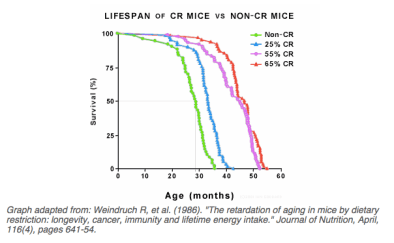
I’m sure you can Google caloric restriction and find a bunch of information on its reported benefits..you would see this chart at the CR society website- the lifespan of calorie-restricted (CR) mice vs non-CR mice. You can see that those whose food intake was restricted by more & more % lived longer. Why do many animals (and perhaps humans) appear to be so well-adapted to eating less? The traditional interpretation of this CR phenomenon is that the dietary restriction effect “has evolved as a way to enhance survival & preserve reproduction during periods of naturally occurring food shortage”. In other words- being adapted to do well on restricted food intake during rough times would have helped our ancestors survive them & stay healthy to have kids later when the food situation improves.
The traditional interpretation of this CR phenomenon is that the dietary restriction effect “has evolved as a way to enhance survival & preserve reproduction during periods of naturally occurring food shortage”.
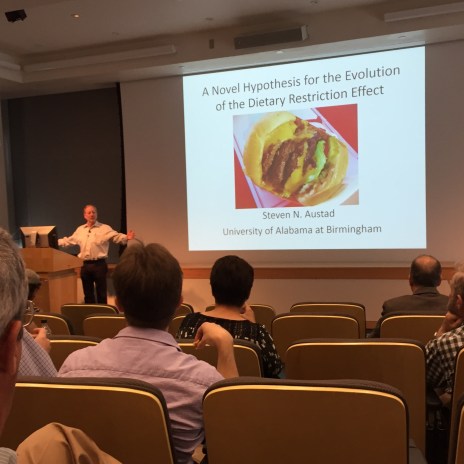
Experimental evidence with animals, however…supports a different hypothesis- the one Dr. Austad (Professor & Chair of the Department of Biology at the University of Alabama) presented to us last week. Again, I wouldn’t be able to cover everything he discussed during the seminar, but I do want to highlight a couple of main points!
I. First, even though the first book on dietary restriction (DR) dates back to the late 16th century, we still do not know the mechanism behind why DR seems to extend life and vigor in animals + delay disease such as cancers. METABOLISM was the original suspect, as metabolic rate goes down with fasting.. however, metabolic rate drops initially yet gradually goes back UP (takes 6-8 weeks to happen).. Since DR changes an unbelievable amount of physiological parameters (see screenshot ->) it is very hard to determine its mechanism.
II. Second, while many sources cite mice experiments showing life extension with caloric restriction.. those experiments are done with lab mice. When DR studies are done with wild mice, DR has no effect on longevity. WHAAAT!! I’ve never heard this before- in fact i was under the impression that CR/DR extends life in animals, period. Well, NO STUDY has ever found that DR extends life or improves health in nature (or even “nature-like” conditions). Mice in the wild actually do not have enough fat stores to reduce feeding except very briefly (wild mice has about 4% fat while a regular lab mice has 15%; also lab mice do not reproduce). In fact, mice in nature simply do not live long enough for the survival benefits of DR to be important. Another challenge to the original hypothesis that adaptation to dietary restriction enhances survival, is that DR increases mortality from some infections. Lastly, DR increases cold sensitivity (and cold is a major source of death in wild mice) and slows down wound healing.
Sounds like animals in the wild would not benefit from adaptation to dietary restriction… yet why is the positive DR effect observed in so many studies so common?
III. Well, even though wild mice do not live longer with restricted diets, DR still results in cancer protection for them. But even more importantly, DR has been found to protect against acute effects of many many toxins! Dr. Austad talks about this discovery in the following way:
.. if animals can not afford to wait to reproduce..and they have to do it even when food conditions are poor, what they will do is broaden their diet. This means they might be ingesting a lot of toxins they are not normally exposed to (foods infected with fungi, new seed types that are well defended by the chemicals they wouldn’t normally encounter). So the hypothesis is that DR acutely induces broad defense mechanisms from a broad range of toxins
Toxicology studies have shown that mice that are calorically restricted survive a wide range of toxins. DR also acts as an acute (vs. chronic) protectant against other problems (see slide below). Renal ischaemia reperfusion injury (IRI) is a common cause of acute kidney injury and we can see that while ad libitum mice are dying steeply by day 7, those on DR of various proportions survive (30% DR is only 70% of normal food intake; ad libitum stands for eating as much as one wants). This is quite impressive!!!
These acute benefits of DR have very important implications. We can think about these effects actually protecting the body against the toxins it itself produces (like free radicals).. it also has clinically relevant advantages- e.g. patients on very strong drug cocktails fasting to avoid harsh side-effects. This suggests that the protective effects of DR could have clinical relevance unrelated to chronic benefits like life extension.
The new hypothesis explaining the evolutionary advantage of this paradoxical effect is that dietary restriction arose as a defense against novel exposure to toxins during food shortage.
So in conclusion.. we saw evidence suggesting that dietary restriction would NOT enhance survival in nature. Yet research has shown that DR increases health and life in a diversity of species. The new hypothesis explaining the evolutionary advantage of this paradoxical effect is that dietary restriction arose as a defense against novel exposure to toxins during food shortage.
My conclusion? I’m still excited about this topic- more than ever before!!! There is a lot of work done now on the timing of food intake as well (not just restricting the amount, but restricting the timing of eating and human health) and I can’t wait to post more about this (after I collect some necessary data though :). Watch out for early May as I’ll be sharing some more info!
This week on ASU campus I managed to attend a fascinating talk: Reconsidering the Role of Plant Foods in Hominin Diets by Dr. Chelsea Leonard.
It was a job talk for the Evolutionary Anthropology department here at ASU and Dr. Leonard is an evolutionary ecologist interested in “human foraging decisions & diet reconstruction”(so- her work would help to clarify what humans ate in the past!) working with Twe populations in Namibia (southwest Africa).
Why does Dr. Leonard study the role of plants? Since shifting towards more meat in diets of early humans has been suggested to be crucial for the unique adaptations in our genus (e.g. large brains), animal foods appear to be very important. There is indeed a strong case for meat in a human diet- in comparison to chimpanzees who are mostly herbivorous (eat plants), the human gut has opposite proportions- our small intestine is much longer, while the colon is a lot shorter. The colon is where fiber fermentation occurs- something crucial if you are eating lots of plant foods (and wild plant foods are very high fiber!). What Dr. Leonard suggests, though, is that meat’s importance in human diets may be quite overstated (especially in meat-heavy “paleo” diets popular now).
The people she studies- Twe- are “forager-horticulturalists”; while the Namibian government has been providing maize for them (this started very recently, in the last 7 yrs or so), they mostly forage for wild foods and have very low intake of animal products. Apparently, historically this population hunted large game and had a higher meat intake.. but the area is very poor in large animals now (and has been this way for ~200 yrs).
While I wont’ be able to describe everything Dr. Leonard discussed, I found the following fascinating.. Based on her observations and interviews with the Twe, she constructed and analyzed a hypothetical (yet realistic) diet for this region. Since Twe seem to be doing just fine health-wise with an extremely low animal food intake (there might be some birds, insects, rodents eaten from time to time), she wanted to test if their meatless diet truly meet basic nutritional requirements.
Based on the plants the Twe regularly eat, her analysis showed that such meatless diet can realistically provide enough protein (it can reach minimum levels of essential amino acids our body can not produce without foods that contain them), it can also provide enough fat (while most plant sources were extremely low in fat, the grass seeds often eaten are rather high in it). The main issue with this meatless diet was calories. Getting enough calories to survive would be improbable : while the hypothetical food intake reaches 1774 calories a day.. only 772 of them are metabolized. What this means is that a lot of these calories are not available to the human body- since humans can not ferment fibers very efficiently, a lot of this rough wild plant fiber is indigestible and does not provide our body with energy.
The main issue with this meatless diet was calories.
Since foraging for wild plants is very labor intensive (and this does not really mean standing around picking berries, but e.g. digging up roots that are about 1 meter (~40 inches) into the ground, or grinding grass seeds and cooking them into porridge), there isn’t enough time in a day to get enough digestible calories from foraging. So animal products are more efficient and provide a concentrated mix of not only essential nutrients, but fat, protein, and calories. While the speaker couldn’t quite estimate the % of calories coming from small game (the birds, insects, etc.), it was very small but still was a part of this population’s diet [note: any time honey was available, it was eaten in large amounts and rather adored, apparently!]. Thus, while a vegetarian diet can be maintained in our modern world with plentiful food supply (and supplementation), it was not possible for non-industrialized populations.
humans are highly adaptable as we span huge geographical areas, and thus no single “diet” “made us human”
We know humans are highly adaptable as we span huge geographical areas, and thus no single “diet” “made us human” (thus, there is no one Paleo Diet). Yet plants are extremely important in our history- we see that they can sustain populations in good health to a very large degree. One issue with studying the role of plants in human diets is that they do not last well archeologically (e.g. it’s much easier to find evidence of large game being consumed, because their remains last well).
while a vegetarian diet can be maintained in our modern world with plentiful food supply (and supplementation), it was not possible for non-industrialized populations.
Overall, this was a really great talk! It also reminded me of a paper I read on the significance of plant foods in human evolution, which I talked about HERE.
[note: if you are an evolutionary anthropologist sand have any edits/clarifications to my post, please comment! I am not an evolutionary anthropologist :)]
I had to write a short, informative, and “unbiased” piece for my work the other month. Posting it here, since it took me a good chunk of the day! 🙂
On November 19th, 2015 the U.S. Food and Drug Administration (FDA) approved the first genetically modified (GM) animal intended for human consumption- AquAdvantage Salmon. The agency reached its decision after 20 years of evaluating research and opinions from a range of sources, including research submitted by the developers themselves (AquaBounty Technologies, a small company in Massachusetts), available peer-reviewed scientific literature, and comments from public hearings and the Veterinary Medicine Advisory Committee. Ultimately, the FDA concluded that the product is safe for humans and animals to eat.
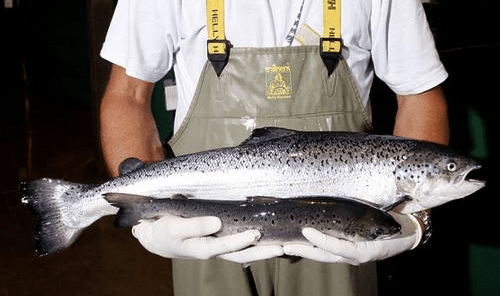
Both GM and regular Atlantis salmon will end up being the same size, but the GM one will grow FASTER (thus, on the pic, it is larger at the SAME age).
What makes AquAdvantage Salmon unique is that it grows 40% quicker than non-modified farm-raised Atlantic salmon. This effect is achieved by inserting fertilized Atlantic salmon eggs with 1) a growth hormone gene from the Pacific Chinook (or “king”) salmon, and 2) a genetic promoter from an ocean pout fish. This promoter keeps the added gene active all year round, while salmon’s own growth hormone gene is only active in the warmer months. These modifications will not lead to any measurable differences in the GM salmon’s look, taste, or it’s ultimate size and nutrition value, but they will make it grow to adult size quicker.
Clearly, growing almost twice as fast is a considerable economic advantage to fish farmers. In addition, the current practice of catching Wild Atlantic salmon for human consumption is not sustainable as the world’s oceans are already seeing declining fishing yields. Another environmental advantage is a reduced carbon footprint of the fishing industry, as the modified salmon can be grown in captivity close to human populations and reduce transportation costs (in the U.S., 95% of salmon is imported). To the consumer, these factors would potentially result in lower prices and an opportunity to make salmon (a healthy protein choice, according to the U.S. Department of Agriculture) a more affordable part of their diet.
Public Concerns
While the FDA has concluded the GM salmon safe to eat, consumers and public interest groups raise important concerns. One potential issue is the fish escaping into the wild and affecting the environment (e.g. competing with wild salmon for food or mating with it and introducing new hybrid species). The escape scenario, however, is highly unlikely when considering the “multiple and redundant” safety measures in place. First, GM salmon can be raised only in land-based contained tanks in Canada and Panama. Second, there are multiple physical barriers placed in both the tanks and plumbing to prevent the escape of fish and eggs. Lastly, the AquAdvantage salmon is female and sterile, making interbreeding highly unlikely.
In terms of human health implications, Genetically Modified Foods (GMOs) already raise concerns among consumers as people consider possible long-term effects from such a novel technology: 57% of Americans surveyed in 2015 said GMOs were unsafe and 67% stated that scientists do not clearly understand their health effects (Pew Research Center). In contrast, the international non-profit organization AAAS (American Association for the Advancement of Sciences) is more confident about our current state of knowledge, stating that:
“the science is quite clear: […] consuming foods containing ingredients derived from GM crops is no riskier than consuming the same foods containing ingredients from crop plants modified by conventional plant improvement techniques”.
(Full statement: AAAS.org) While GM salmon is now approved for sale (though it will take about two years to reach the market), some retailers have already pledged to avoid the product (e.g. Whole Foods, Trader Joe’s) reflecting such consumer worries.
The Labeling Question One aspect of the FDA ruling saw particular opposition from public groups: GM salmon will not require labeling. While the FDA issued two recommendations for manufacturers to voluntarily label the product, the agency can only require additional labeling if a material difference is present between a GM and non-GM salmon (e.g. differences in nutritional profile). As no such material distinction has been found, a mandatory labeling might incorrectly imply an essential difference between the two.
Another issue with requiring labeling is that a “genetically modified” food is not necessary a meaningful category, and the choice of foods to include in it would be quite arbitrary. After all, humans have been modifying the food supply in various ways for quite some time. This includes “wide cross” hybridization resulting in plants not found in nature (including “heirloom” plant varieties often perceived as more “natural”). Another example is radiation and chemical mutagens that are used on seeds to generate new strains (e.g. a Ruby Red grapefruit, which can carry the “organic” label, was created via mutation due to radiation exposure). In comparison to these methods, genetic engineering is arguably the most precise and predictable technique at the moment.
As a consumer, you have a chance to read and comment on the FDA’s proposed guidelines for the industry’s voluntary labeling of GM salmon until January 25, 2016: FDA Regulations
The annual American Anthropological Association (AAA) meeting has ended! This is my 3rd year attending and it is still as crazy, overwhelming, and fun at the first time. 🙂
The 2015 meeting was in Denver, CO (gorgeous gorgeous city! My first time there) and I wanted to write down a couple of impressions and things learned from this year’s event.
SO, first of all- what I presented on.. This September I began collecting my dissertation data. I also got accepted for a poster session for the Anthropology Society for Food & Nutrition at the AAA, thus I knew I’d better have an interesting poster ready by mid November. :S
Finishing up interviews while in Finland!
It was rushed & stressful (when is it not?), I had to put together the poster & print it from Finland (I was traveling constantly before the AAAs!) but it got done.
My poster showed some preliminary results of how people (from mostly urban southwestern US) talk about healthy eating. I mostly focused on results from the pile sorting interview (presenting visual “maps” of how the 42 cars people sorted can be represented in 2 dimensions when averaged over 30 participants). I also talked about the several distinct “theories” of healthy eating that emerged from the interviews (using Q sort agreement rankings). I got good feedback and some very crucial suggestions for further work!
Two hours of poster talking! :S Exhausting but great.
Of course, I also attended a bunch of amazing talks! Some of my favorites are summarized here:
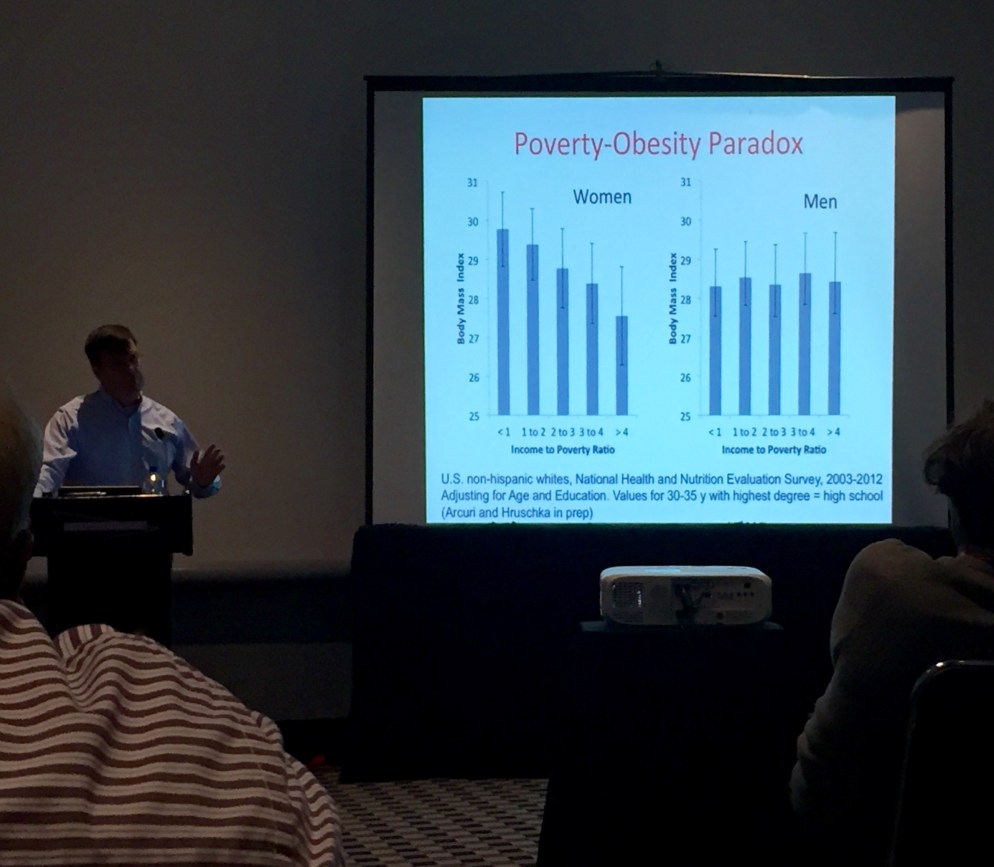
Dr. Hruschka’s talk in the Environmental Anthropology session was one of the best (he is also my PhD committee chair :P). In his presentation, he mentioned the highly fashionable explanatory model called the reverse gradient. This is an observed pattern in the US (& other high-income countries) where poor women have higher levels of fat (on average) than women who are more wealthy (this is reversed when compared to the REST of the planet, where increasing resources correlate with increases in body weight).
Many assume it has to do with poverty and not having time and resources to eat well and exercise. But actually, a great deal of data supports a different explanation: the body capital hypothesis. This hypothesis proposed that the anti-fat discrimination in marriage and jobs actually limits the economic mobility of people (particularly females) who have more body fat. So- husbands and employees seem to discriminate against heavier women.
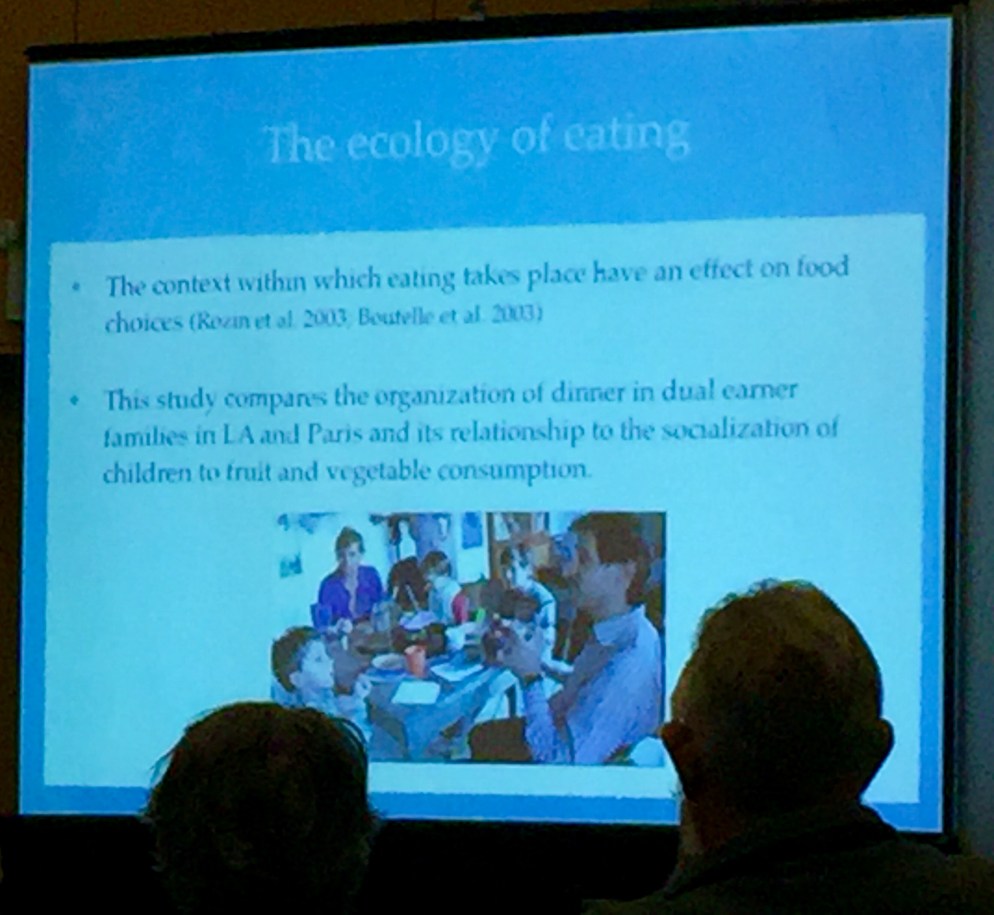
Another cool talk I heard was by Dr. Tamar Kremer-Sadlik (UCLA)who looked at the “ecology of eating perspectives” or the context in which eating takes place. Her study video recorded typical dinners in US and French families. They noticed that the existence of courses (so like a salad, main dish, dessert) reduced competition between foods and resulted in kids eating more vegetables. In other words- if your dinner table’s meal structure has few divisions into course (US families tended to have a single course + dessert, so all foods were served together), the presence of vegetables an be easily overshadowed by everything else available. In order to “share” a meal, you need to collaborate- if you have a single course, that collaboration exists whether you specifically eat the vegetable part of the dish or not (as you take some of the food offered).
In the French family dinners, they saw a lot more division into courses (starter, main, salad, cheese, yoghurt and fruit). To be collaborative during each course, one has to eat some of whatever is served at each course. If most of the courses include vegetables, the kids would overall eat a lot more vegetables over dinner. To quantify this difference: 47% of American kids didn’t touch vegetables, while only 10% of French kids didn’t.
One last fun lecture I went to was called “Pet Ownership as Cues of Character” by a group from University of Colorado Springs (Evolutionary Anthropology session). They began by saying that many studies have found that women and men attenuate to cues of attractiveness differently: women seem to pay more attention to cues of character os success. For example, one study showed that women rated men paying positive attention to an infant as more attractive, while men did not rate photos of women differently (whether they were paying attention to infant or ignoring it).
So this group hypothesized that perhaps women conflate cues of parenting ability into attractiveness. They tested it with pet ownership, instead of having a baby! They asked US respondents to rate photos of individuals in 3 scenarios: paying attention to a dog, ignoring the dog, and a neutral/reading book photo. To their surprise, they found that only MEN rated women as MORE attractive and as MORE desirable partners when shown the photo where women pay positive attention to the pet.Women were not rating males with pets as more attractive. While the study could have some important flaws, that’s a pretty cool and intriguing outcome.
There were a LOT more talks I found fascinating, but it is too overwhelming to mention them all 🙂 #AAA2015
My ambitious plan to post simple summaries of cool research studies every Friday did no go as planned this Fall. Not only have I traveled internationally to collect data (dissertation, here I come!), but I also have 5 fantastic undergraduate apprenticeship students “working” in my lab this semester. So- a lot of time has been spent on training, learning how to train, and organizing/cleaning/analyzing the data they help collect for my work.
Nevertheless, it’s time for another post.
Have you heard that fish is healthy for you? That Omega 3s, the “good” fat, is crucial for health? Or have you heard the opposite and are totally confused?
It wouldn’t be a surprise if you were.. Perhaps you’ve seen news posts like this ->
In my interviews with folks in US and eastern Europe, the conversation includes”healthy fats” quite often. Everybody “knows” fish is healthy and we should all be trying to eat more omega 3 fats that are abundant in fish products for a healthy heart.
Yet in the last several years, many online sources reported on studies that refute these claims.
In this post I’ll briefly summarize a 2014 paper by Grey & Bolland. I believe you can even access it for free by clicking here.
Full reference: Grey, A., & Bolland, M. (2014). Clinical trial evidence and use of fish oil supplements. JAMA internal medicine, 174(3), 460-462.
What Grey & Bolland did was look for the best scientific work on the topic of omega 3 fats and how it affected sales of these supplements. Grey&Bollard summarized18 randomized clinical trials (between 2005 and 2012) that were published in high impact journals (=highest quality journals respected by the scientific community). Randomized clinical trials (RCTs) are considered the gold standard of research and present the highest level of evidence, so if you’re going to look at scientific support for any idea- clinical trials are the way to go!
What did those 18 studies show: well, only 2 studies reported benefits: a 2007 RCT on ~18000 people and using EPA for major coronary events, and a 2005 meta-analysis of RCTs on ~20000 people looking at effect of omega-3 oils and mortality. The other 16- no benefit… Fish oil sales? In the US between 2007 and 2012 fish oil and omega 3 supplements increased from $425 to $1043 million (!). Similar sales pattern were seen in England and Australia+asia. Technically, that’s not logical- if randomized clinical trials are the best and most robust type of scientific evidence, shouldn’t it influence current practices? The authors write:
“Since 10% of adults in the US take an Omega-3 or fish oil supplement, most commonly for heart health or to lower cholesterol, the null results of 9 of the 10 RCTs and 5 of the 6 meta-analyses studying cardiovascular disease might have been expected to influence use”
I have pulled up the 2005 meta analysis- one of 2 studies from the review that showed benefit to supplementation- to get a bit more detail on the results. Studer et al (2005)* analyzed 97 studies to examine the safety & efficacy of various lipid-lowering interventions using mortality data (= they looked at lipid-lowering supplement/drug use and how often people who took them and didn’t take them die. The separated deaths into 1)either from all causes, 2)cardiac events, and 3) noncardiovascular causes). Such large-scale analysis of these randomized controlled trials is a very important tool- it allows to look at the overall benefit of interventions. This meta-analysis found that two supplements/drugs had reduce risk of overall and cardiac mortality (deaths from all causes and deaths from cardiac events specifically): statins and Omega-3 fatty acids.
Sounds wonderful, but again: it was only 1 of the 2 studies that showed statistically significant benefit of Omega-3s, while the other 16 did not. (statistically significant= meaning something happened Not by chance alone)
* Full reference:Studer, M., Briel, M., Leimenstoll, B., Glass, T. R., & Bucher, H. C. (2005). Effect of different antilipidemic agents and diets on mortality: a systematic review. Archives of Internal Medicine, 165(7), 725-730.
So why do more people continue taking the supplements? Well, first of all, we can assume the public doesn’t read original studies and can be victim to “industry spin”. The “spin” used by industry is a strategy to hype findings and distort the results of clinical studies. Wang et al. (2014) in fact looked this: they analyzed 47 supplements industry press releases & 91 non-industry press releases in response to 46 clinical studies of supplements (published between 2005 & 2013). Result? 100% industry press releases contained “spin” while only 55% of non-industry media pieces did. Industry press releases also reported less on study details – outcome, sample size, effect size- specifically for studies that found no benefit of supplements.
Full citation: Wang, M. T., Gamble, G., Bolland, M. J., & Grey, A. (2014). Press Releases Issued by Supplements Industry Organisations and Non-Industry Organisations in Response to Publication of Clinical Research Findings: A Case-Control Study.
So why else? Well, omega 3 supplements aren’t terribly expensive and people don’t associate them with any RISK, so it makes sense that folks would rather be “on the safe side” and take them. Also, the belief that these fats are “good” can be rather long-term and hard to change- I remember my childhood friends in Ukraine suffering through spoonfuls of fish oil given by their parents. So having a strong long-term belief that fish oils/omega 3s are beneficial can create confirmation bias: looking for evidence that you already agree with and dismissing new research that doesn’t fit your view.
Lastly.. how can fish fat not be beneficial? While I, of course, can not answer that question, here is an interesting piece of the puzzle- genetic adaptation. While I was preparing for a lecture on evolution and human diet, I saw a fascinating research piece at the National Institutes for Health website. Originally, the focus on fish oils came from studies with the Inuit and they seemed very healthy on their traditional fat-rich diets (fat coming from marine sources). So it was thought that fish oil would have a protective effect against cardiovascular disease.. But Dr. Nielsen states:
“We’ve now found that they have unique genetic adaptations to this diet, so you cannot extrapolate from them to other populations”; “A diet that is healthy for the Inuit may not necessarily be good for the rest of us.”
To supplement or not to supplement, then?
Looks like it is not clear whether dietary supplements with omega 3 fats really influence deaths from cardiovascular causes (strokes, heart attacks) or other causes (cancers) in the population. Yet there is also no evidence that we need to advise people to stop taking these supplements. I suppose it doesn’t hurt..unless it hurts your wallet too much.. Your wallet deserves some good support coming from a good number of randomized controlled trials. 😉
Note: This Fall I decided to attempt even more science communication! The Sci Files (imagine the x files theme playing) will be a collection of health & food-related research articles that I summarize in plain(er) language. I became quite passionate about breaking down hard-to-understand research for the public audience and I’ll try to do my best, considering I’m no expert! Yet 5 years of graduate courses- statistics, research methods, nutrition psychology, evolution & medicine- at least give me skills to understand a lot of the material that might be overwhelming to a lay reader. I will try to keep the summary to one page (~500 words), possibly followed by extra material that could be interesting 😉
For the first Sci File, i’m looking at a paper discussed yesterday during a lecture on the paleolithic diet. It’s published in 2015 in The Quarterly Review of Biology and the title intrigued me “The Importance of Dietary Carbohydrate in Human Evolution”. I’ve heard multiple talks on how the various “paleolithic” diets could have included starchy foods, but I didn’t think they were substantial parts of such diets. Original paper: Hardy, K., Brand-Miller, J., Brown, K. D., Thomas, M. G., & Copeland, L. (2015). The importance of dietary carbohydrate in human evolution. The Quarterly Review of Biology, 90(3), 251-268.
Short summary:
Apparently, you can delete the “NO” and still keep calm 😉
The authors propose that carbohydrates- particularly cooked high starch plant foods like tubers & roots- were essential in the evolution of our species- especially for the quick expansion of the human brain. They support this by showing that (1) critical development of this large glucozse-hungry organ required digestible carbohydrates, and eating cooked starch would really increase this energy availability to the brain (+ other glucose-hungry tissues such as red blood cells and the developing fetus).
They also show that the mutation in the enzyme for digesting carbs (salivary emylase, AMY1) co-evolved with both cooking and eating starchy carbs, giving an advantage to early humans. To put it in simpler terms: carbs were quite important, as shown in our increased ability to digest cooked starch (otherwise, why retain this mutation if we did not rely on cooked starches for a substantial amount of time?). A meat-heavy diet wouldn’t have provided sufficient glucose or energy to the growing brain + 1) large amounts of protein are in fact toxic and 2) providing sufficient amount of animal-based food would require too much effort:
“the energy expenditure required to obtain it may have been far greater than that used for collecting tubers from a reliable source”
Some Context:
There is no clear agreement on what constituted a “Paleolithic diet”, but it makes sense to assume that our current physiology should be optimized to the kind of diet we had during our evolutionary past. Some important features in our evolution are considered linked particularly to key changes in diet: smaller teeth, smaller digestive tract (1.8 mln years ago), larger brain size (began ~2 mln yrs ago; accelerated around 800,000 yrs ago), and better aerobic capacity (ability of the heart and lungs to get oxygen to the muscles) about 2 mln years ago.
Early hominins include modern humans, extinct human species, and all our immediate ancestors
Some have argued that these changes happened because humans transitioned from a diet based on fibrous plants to mostly meat-based diets.. But this paper offers evidence that both plant carbohydrates (carbs) and meat were crucial in human evolution. In their words:
“We contend that in terms of energy supplied to an increasing large brain, as well as to other glucose-dependent tissues, consumption of increased amounts of starch may have provided a substantial evolutionary advantage to Mid-to-Late Pleistocene omnivorous hominins“.
This photo is missing some starches!
Actual physical remains of early hominins are quite rare, so there is a lot of uncertainty about their lives. As already mentioned, there were several important changes in hominin morphology (size,shape,andstructure of an organism) related to the appearance of Homo erectus (teeth, digestive length, brain). Anthropologists propose that they occurred with a change from a “high-volume, low-energy diet” (lots of fibrous plant material that’s not very calorie rich), to a low-volume, high-energy diet (so foods that are more packed with energy like meats and starchy roots & tubers).
It looks like climate fluctuated between moist and dry periods, which required flexibility in diet (omnivory).. Increased meat consumption has been suggested as an important buffer against such environmental change (and helped expend into new unfamiliar environments), but high starch plant foods might have also been a very common and important part of the diet- especially when cooked. The timing of widespread cooking is not known, but it is argued that it was long enough ago to allow for biological adaptations to take place.
Note: Secure evidence of the use of fire to cook dates to about 400,000 years ago, though some suggestive evidence for a relationship between humans and fire dates to at least 1.6 mln years ago.
The fact that early hominins ate starchy foods is supported by various evidence (the paper goes through rather wordy technical anthropological examples that I fail to summarize in a simpler way). But while meat-eating evidence usually survives (e.g. animal remains with cut marks suggesting being butchered), evidence for plant foods doesn’t, which makes it hard to reconstruct ancestral diets based on physical remains alone (and biases them towards exaggerating meat eating).
Co-evolution of cooking & carb-digesting genes
Humans have the ability to digest starches with the help of enzymes in saliva- salivary amylase! AND humans are quite unusual as we have high levels of these enzymes, suggesting an adaptation to diets rich in cooked carbohydrates. Also, people from populations with high-starch diets have generally more AMY1 copies than those that have traditionally low-starch diets (hey! adaptation!).
Amylase (salivary amylase or AMY1)- enzyme that begins digesting starches in the mouth as it’s present in the saliva. Authors hypothesize that cooking and variation in the salivary amylase gene copy number are correlated.
The variation in copy numbers of salivary amylase genes is an important point of the paper – these enzymes are pretty much ineffective on raw starch, but cooking substantially increases their potential to provide energy/calories. So multiplication of the salivary amylase (AMY1) would become selectively advantageousonly when cooking became widespread. (It’s been estimated that the three human AMY1 genes have been evolving separately for less than 1 million years). The authors theorize a gene-culture co-adaptation scenario here: cooking starch-rich plant foods (cultural evolution) coevolved with increased salivary amylase activity in the human lineage (gene evolution). Without cooking, eating starch-rich plant foods probably couldn’t meet the high demands for preformed glucose noted in modern humans.
Note: A mutation that is selectively advantageous means a change in DNA that gives a survival advantage to a particular genotype under certain environmental conditions. SO in an environment where starches are available (e.g. you can find a lot of roots and tubers) and humans have learned to cook, having more copies of the AMY1 gene that aids in digesting cooked starch would allow those folks to survive more (e.g. in times of food crisis when they can’t hunt or gather other sources of food, etc.) vs. folks who don’t have that mutation.
To further test the paper’s hypothesis, we need “a convergence of information from archeology, genetics, and human physiology”. So let’s stay tuned 🙂
Well, i’m at around 900 words, which is more than the summaries i hope to do in the future! In my defense, this paper was FULL of fantastic information, often rather technical and challenging to explain in less words. I do have some extra content below i found fascinating if you found this summary interesting!
Most people don’t read original research articles…why would they? They might have an access fee or be too technical to comprehend for the normal lay person. Yet many websites report on results of those “recent studies”. I’ve seen many health websites sensationalize new super important work in peer reviewed journals.. just to realize that the journal it’s published in is rather suspicious.
Recent example: one anti-vaccine website posted a list of studies that apparently showed the danger of vaccinating. I wanted to read the very first article on that list and the website provided a PDF. I found myself thinking the results were a bit too extraordinary [see infographic towards the end of this post for HINTS on spotting a suspicious article] … I noticed it was published by some asian journal with a strange-looking website. I proceeded to search for this same article on Google Scholar and guess what? it did not exist there. That’s just fishy.
Certain journals have big names and high reputations and are easily recognized (especially by academics). I read a lot of fantastic research articles in Appetite, for example, on the psychology of eating. So we as a research community generally “know” what kinds of journals publish high quality science. YET, even researchers have to be careful to avoid trashy journals that have no standing in the scientific community.
What is a “bad” journal: one that publishes low quality work, basically; something that a high reputation journal with scientific standards would not consider publishing. Bad journals often publish anything for a fee, and while they state they are “peer reviewed”, nobody really does any good reviewing, if any (I even saw a case where one of the lister reviewers was a diseased academic). The peer review process is supposed to ensure that your work actually uses real data, appropriate methods, sound conclusions based on the results, etc. It’s supposed to protect us from reading and taking into consideration fake, unscientific, biased work.
Who publishes in these trashy journals? It can be young academics who are just trying to publish their research and get duped to pay a lot of money to one of these predatory journals. It can also be bad researchers with bad studies who could never get their trashy work into a good peer-reviewed journal in the first place (yet they can pay to publish, pay to announce this publication, and watch the internet sensationalize their misleading work).
One way to know a journal is high quality is to know the publisher is high quality (some famous ones are Elsevier, Springer). Also, some websites post a list of journals (as well as list of publishers) to avoid. Check out THIS BLOG. Both academics and public alike can be fooled by low quality journals- they often have legitimate-sounding titles, resembling prestigious journal titles; they have professional-looking websites, etc.
Great guide to spotting poor-quality journals!
Lastly, while a lot of bad research can be published in bad journals..some poor research can get published in decent ones. A poor study, though, will eventually be retracted. Please follow RETRACTION WATCH to be up-to-date with such work! Otherwise, you could be falsely spreading information about research that was low quality in the first place (e.g. good example is the Seralini rat study on GMO feed (read more here).
I’m not usually inspired to blog about anything non-food related.. yet when you wake up in the morning feeling well after literally crying yourself to sleep with pain the night before.. WELL you feel inspired to share 🙂
The Pain is Real
2 days ago I began having strange deep shoulder pain that would bother me when I moved a certain way or inhaled deeply. Since I do aerial (e.g. silks, aerial hoop) and know many people who get injured by not warming up enough or doing a move wrong.. I immediately assumed that i pulled a muscle the day before when I was trying tricks on the playground. It seemed like the most logical explanation, though I was bothered by one problem: I did not feel an injury as I did various inversions. When you pull something, you normally notice something immediately and I did not.
My immediate explanatory model for the pain was my aerial practice the day before- it seemed most plausible that I pulled a muscle while inverting (and not warming up). The alternative explanation of AC blowing on my neck for my 6 hour car trip seemed silly in comparison.. yet turned out to be true.
On the next day the pain spread and was following me all morning no matter what I did- inhaled, sneezed, turned my neck to the left, lifted my arm. My Romanian in-laws, upon hearing my complains, suggested it was due to having AC on in the car while driving from AZ to CA. Having lived in the US for too long, I quickly dismissed this scenario. I suppose I forgot the fear of the draft i’ve been instilled with in childhood. Somehow, Americans do not generally hold the belief that cold air can cause issues, though you hear about this in so many other cultures. Germans, Japanese, Russians- they all can tell you some stories about the dangers of THE draft. I heard so much back in Ukraine about not sleeping with a window open or not having your window down while driving, that I took it for granted.. yet absolutely lost this caution in my new country of citizenship!
The Folk Remedy
After multiple muscle creams, tennis ball massages against the wall, and resting.. the pain just made me want to miserably walk around sobbing and eating chocolate… Then came the miracle of an old Romanian folk remedy. It was a very sophisticated procedure: I got rubbing alcohol… rubbed around the painful area…and covered with a towel to keep warm before bed. Ta….da….
When I woke up, I couldn’t believe that the horrific suffering of the day before was simply gone. It did make me smell like a cheap alcoholic mixed drink for about 15 minutes after I got covered and wrapped (my friends politely sat away covering their noses with their t-shirts), but that was the only side-effect i experienced. The relief the next morning was so unexpected it felt like magic– and even prompted me to share this little story in my blog!
Fear the Draft
THE MIRACLE REMEDY “THEY” DON’T WANT YOU TO KNOW ABOUT :))))))
I later talked to my parents, who said “ohh. well, that’s myositis!! why the hell didn’t you tell us, we’d tell you what to do!” They say that it can last for weeks if you do not do anything about it. I shuddered at the thought of enduring that horrible feeling for more than two days straight :S
I later Googled “horrible shoulder/neck pain caused by cold air” in need of an official explanation. It looks like cold air blowing on certain parts of the body (seems like neck area is particularly vulnerable) for a period of time without movement (like when you sleep..OR when you drive from AZ to LA with cold AC blowing on your neck 🙂) can cause your muscle to stiffen and thus lead to this horrific deal. My friend, a PT, also told me over the phone that my muscle must have spasmed and I managed to increase the blood flow to it with the alcohol. Such biomedical explanatory stories satisfied my curiosity- not like I needed them to get rid of the pain, yet the mind simply needed to understand!!
Well.. big YAY for cheap rubbing alcohol from CVS & the fantastic human ability to transmit cultural knowledge through generations in the form of folk remedies!

 when I visited last. Anything from foods to chewing gum to water bottles boasted the round green NO GMO sticker. Most people I discussed it with actually acknowledged it was simple marketing and didn’t place much trust in the stickers anyway..
 Exciting day! Another diet-related talk at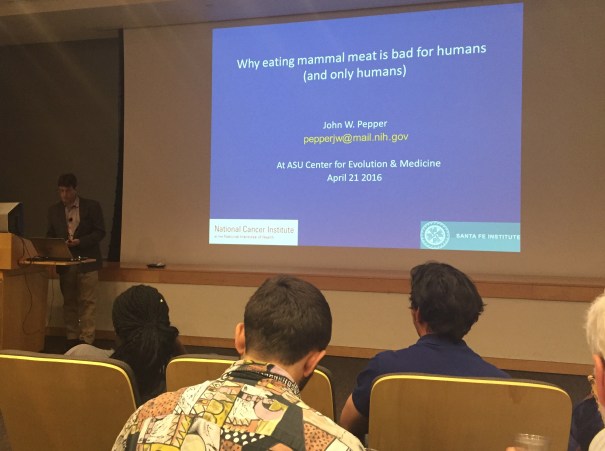


 (I wrote a whole research paper on it in the first year of my master’s degree). You might have heard of intermittent fasting (e.g. popular in the CrossFit world), or the CR Society ( http://www.crsociety.org/ )- all are related to the concept that restricting food intake results in health benefits (from extending life to preventing and reversing disease).
 Why do many animals (and perhaps humans) appear to be so well-adapted to eating less? The traditional interpretation of this CR phenomenon is that the dietary restriction effect “has evolved as a way to enhance survival & preserve reproduction during periods of naturally occurring food shortage”. In other words- being adapted to do well on restricted food intake during rough times would have helped our ancestors survive them & stay healthy to have kids later when the food situation improves.
 dates back to the late 16th century, we still do not know the mechanism behind why DR seems to extend life and vigor in animals + delay disease such as cancers. METABOLISM was the original suspect, as metabolic rate goes down with fasting.. however, metabolic rate drops initially yet gradually goes back UP (takes 6-8 weeks to happen).. Since DR changes an unbelievable amount of physiological parameters (see screenshot ->) it is very hard to determine its mechanism.


 important. There is indeed a strong case for meat in a human diet- in comparison to chimpanzees who are mostly herbivorous (eat plants), the human gut has opposite proportions- our small intestine is much longer, while the colon is a lot shorter. The colon is where fiber fermentation occurs- something crucial if you are eating lots of plant foods (and wild plant foods are very high fiber!). What Dr. Leonard suggests, though, is that meat’s importance in human diets may be quite overstated (especially in meat-heavy “paleo” diets popular now).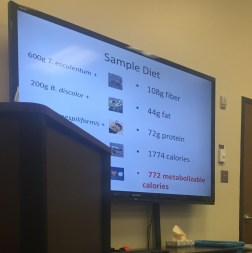


 Association (AAA) meeting has ended! This is my 3rd year attending and it is still as crazy, overwhelming, and fun at the first time. 🙂


 news posts like this ->
 puzzle- genetic adaptation. While I was preparing for a lecture on evolution and human diet, I saw a fascinating research piece at the National Institutes for Health website.


 Mariya V. PhD